
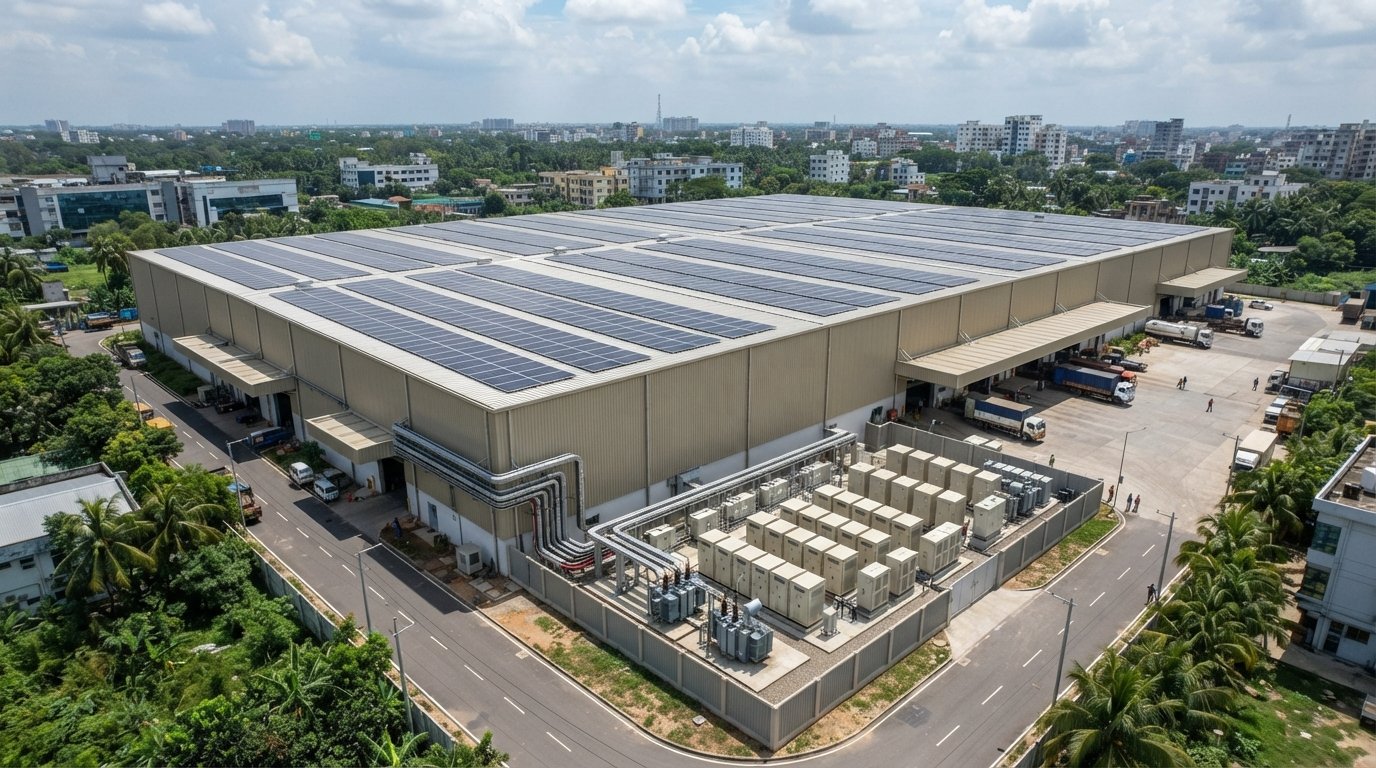
Evaluate rooftops or land against daytime demand, structural conditions and the connection strategy before committing to capacity.
Energy Storage & Resilience
Connect daytime generation with the hours that matter.
Model solar output, site demand and battery operation together. Storage adds value when there is a defined energy-shifting or backup requirement.
INTEGRATED ENERGY ARCHITECTURE
See how the system can operate.
SELECT A COMPONENT
Grid
Normal supply and connection point. During an outage, a suitably designed islanding scheme must separate the facility from the grid.
OPERATING SCENARIO
Grid and available solar serve facility demand. BESS follows the defined reserve and scheduling strategy; the generator is normally on standby.
Communications and switchgear integration
Define the device interface schedule, metering points, breaker status, permissives, interlocks and synchronization logic. Assess device-supported Modbus TCP/RTU or IEC 61850 interfaces where appropriate; support and gateway compatibility must be confirmed for the selected equipment.
Conceptual architecture, not a construction single-line diagram. Highlighted lines indicate possible energy paths, not measured output. Protection, islanding, earthing, synchronization and transfer performance require project-specific engineering.
BUSINESS OUTCOMES
What this can help you achieve
- Use selected renewable surplus later.
- Support critical loads within the engineered reserve.
- Coordinate solar, grid and generator operation.
TECHNICAL UNDERSTANDING
What the design needs to establish
- Time-aligned generation and demand data
- Charging windows, reserve policy and discharge duty
- Round-trip losses, degradation and connection rules
Explore your requirement
Related solutions and delivery support
Start with critical load, outage duration and operating consequences. Select the architecture and battery technology against that duty cycle.
Define how each source operates in normal service, supply interruptions and extended outages, with clear load priorities and recovery rules.
Connect the technical requirement with assessment and project delivery.
Relevant industries
Production interruptions, daytime electricity costs and suitable factory roofs.
Sensitive production, controlled environments and essential utilities.
Process interruptions, refrigeration and variable production demand.
Temperature continuity, compressor demand and outage exposure.
Build your technical understanding
Understand why kW and kWh answer different questions.
See what a useful assessment needs to establish.
YOUR NEXT STEP
Turn this requirement into a project brief.
Share your site, operating priorities and available data. Start with an assessment, arrange a survey where needed, then discuss the project scope.